Sprint Day 2 Blog
Today I’m talking about the unique features of Immortal Dragon and why I built them.
In my previous writing, I layed out my key beliefs:
- Interactive real-time is the direction all media is heading
- Our brains evolve with our interfaces, shaping us
- Our interfaces are insufficient and leave us ‘root bound’
- My cognitive qualities (poor memory, difficulty focusing) are in part results of the impact of these interfaces
The net result of all this a fragmentation that effects space, time, meaning - and ultimately relationships.
Yet I’m drawn back to these interfaces by dopamine-seeking behavior - searching for stimulation, connection or information.
Could Immortal Dragon be a source of dopamine, meaning, peristence and memory. MAYBE.
Disclaimer: all this is conjecture.
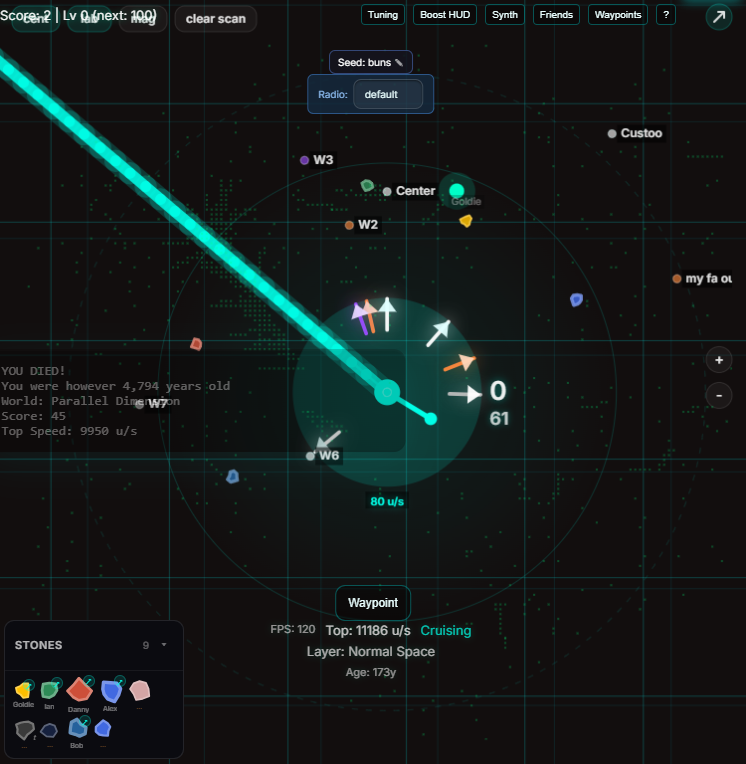 Above is a zoomed in view on the user, their shell, field, various waypoints and azimuth, and in the lower left - an inventory full of rocks.
User
At the center of the experience is the user - represented by a glowing circle: their aura - and a tail: their timetrail. The user uses the arrow keys to aim, and space to propel themselves in the direction. The movement feels something like ice-skating. The impression is that the user can move in any direction freely, at their own pace - like flying in space.
Virtual Soul
One could look at this representation as a ‘light-body’ or seat of the soul. Some might call it a merkaba or chariot. I like these interpretations. Humans are celestial creatures expressed imperfectly in our current form - our connection to the internet is our reunion with light - and our current paradigm of profiles and algo timelines is an expression of generational lock-in. For us to evolve past our current world where we live virtually in someone else’s spreadsheet - I believe we have to develop a new relationship with our idea of ourselves. This is what my experiments in interfaces attempt to do. I am my own test subject.
Spatial Metaphors
Our current web builds on the metaphor of the written word - web pages, scrolls, typefaces. It is familiar and bridges our experiences with the past - but remains an artificial imposition of structure. The open space of Immortal Dragon first breaks the convention of the page.
Time, Distance, Presence
On the internet, our sense of time and space imposed by the interfaces of the websites that we frequent. We have a rough sense of linearity on our timelines (now complicated by algorithms).
My question with Immortal Dragon is: Can I create an interface that expands a user’s experience and vantage of time. If modern web interfaces constrict our viewpoint, context, and scale at which we can interact with information, meaning and relationships - would an expanded metaphor enhance our ability to build meaning.
Mapping, Waypoints, Names
In this model of spatial navigation - the goal becomes mapping the space and giving it meaning and structure. The user can name planets, place waypoints on the map, collect and name stones. Through this process they build a mental model of the space, and give it life by
Soul Compass and Its Bearings
Orbits
Stones can be put into orbit around planets - when put into orbit, the stone is given a period (the time it takes for the stone to make a full revolution around the planet ) - this is a kind of periodic reminder system.
Stones, Gems, Rocks
When travelling near a planet - a user can harvest rare gems, stones and soon other objects from orbit. These items enter the user’s inventory as unique namable objects to which notes, memories, locations and relationships can be attached.
Memory Addresses
Feature Idea Story
Stones and other objects are portable memory addresses. Their unique and visual qualities give them mnemonic qualities. This is something that I’ve attempted in my lived environments - I place objects around my house and studio to remind me of things - people, philosophies I’d like to remember and embody.
My Larger Theory of Memory
Persistent, Permanence
Toroidal Navigation
This is a funny one. I’m interested in understanding physics - because ideally that’s where everything meets. Possibly part of our modern psychosis is being impacted by technologies developed using the principles of new physics like quantum - while not being able understand what these physics principles imply.
Because I learned perspective at an early age, perspective as a means to collapse space via projection became a mode of thinking for me -
At some point I became interested in the bizarre idea that the universe is fundamentally a torus - interestingly that is also the solution for a square, finite and looping space.
Virtual Reality
Some respond to this with: ok. VR. If the world is space, then our interfaces should be too. We put buttons on a wall and locomote across a ill-scaled diorama of a pointless and disconnected space. Alas, we fail again. Our virtual shoes squeek - and plus: we have no legs. Why are we doing this again? This headset is making my face sweaty.
Projection
In hopping into the virtual word, we skip projection. Projection is the process of mapping information across spaces - in 3D, virtual space is projected onto a 2D plane for our eyes to decode and understand the perspective. This is geometric, efficient and not without influence - though it can feel objective - projection encodes viewpoint, framing, and distortion - each of which alters what we’re looking at, our distance, location in space, and relative size of elements invisibly.
By assuming the absolute nature of this projective space we assume objectivity - and lose the use of projection as a communication tool.
Thus our naturalized two dimensional feeds: infinite pages we scroll insist objectivity of information and contain embedded perspective, framings and omissions which assert objectivity. In other words: bubble worlds within bubble worlds. A track, a timeline, an insisted frame.
Projectionism
A future tool then, might - render the assumed frames of a projective space as elements to be questioned - it might also make the mechanisms of projection and framing malleable and usable. What would such a tool look like?
Well, it might create a layer of symbols that allow the authorship of the process of projection - mapping. Within the framework of the page - our tools are limited to those we can imagine in a flat space.
Within the framework of a space coded with metaphor ~ objects become operators on information meaning. A rock represents