Sprint 1
I’m doing a sprint until March 1st. ~10 DAYS.
February 18, 2026
What I’m Building and Why:
In the last 10 years or so, I’ve been steadily moving away from VFX and 3D rendering work towards real-time experiences and interfaces. In the last year or two - a new goal has emerged: making platforms. But why?
Towards Realtime
Originally, my motive was to move beyond pre-rendered images, as I saw the future to be interactive. Waiting hours for a static image to complete bored me. I grew up playing computer games and believed that eventually that fine-tuned interaction loop would be present in all media. It was only a matter of time. 8 Years ago I gave a presentation called ‘Towards Realtime’ where I spoke of my early experiments and complained about file-management. But it was deeper than that:
I have many memories of babysitting whirring computers in a VFX office till early in the morning and watching samples fill in and myself get old. Rendering feels like waiting for a future that is obsolete by the time it arrives. Dramatic
As I get older, I feel less compelled to produce images of imaginary worlds and live in them. I spent my youth imagining elsewhere now - I kinda just want my real-world back now. Stories are great - but - I wish to engage with them at my choosing - and in the internet right now with algorithms the worlds were being submerged in feel mandatory.
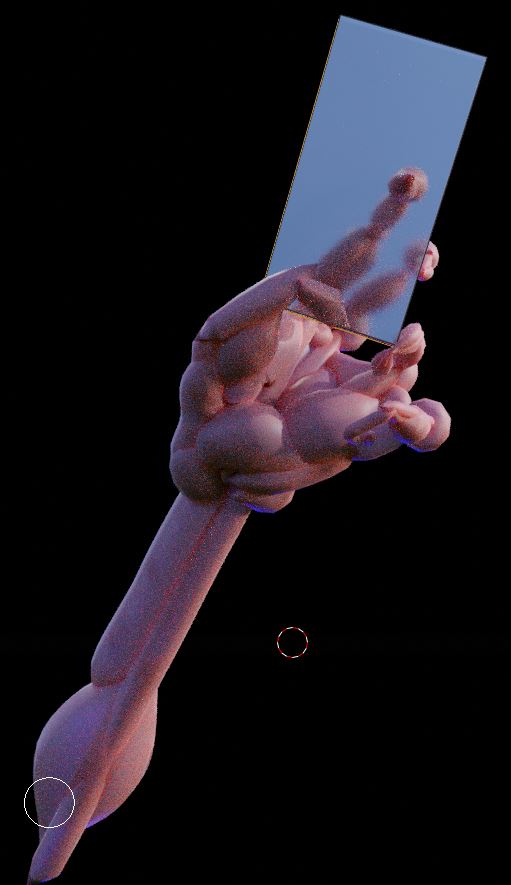
Root-Bound Interfaces
As my brain has now grow aged with the interfaces I grew up - I’ve noticed that my mind is knotted up in them like a root-bound plant. It amuses to me think of my mind as having little roots that wind around app interfaces like a hungry worms. But mostly it makes me angry. Our social interfaces are deeply important - they define how we interact with others and ourselves. To think that my mind has been shaped by companies that don’t have my best interests in mind is infuriating. And there are tangible impacts:

.png) Impacts
Impacts
I’ve come to notice how my focus, attention and memory are shaped by the interfaces I use everyday.
- I view things and instantly forget them - a refresh wipes a tweet from existence, a timeline reshuffles and hides the past, a landing page shows 20 options designed to grab attention.
- I don’t have places to put things even if I wanted to - bookmark folders are where things go to die.
- I’m constantly having ideas that are not mine put in my head without my permission.
- The algorithm is getting increasingly effective at echoing me and gives me the creepy feeling that someone is reading my thoughts.
The result is that I am a disoriented, confused, inundated, goldfish navigating an infinite maze made by monkeys with machine guns. Oh and my brain is transparent. Cool. No wonder I feel on edge.
I’ve come to refer to the bulk of these effects as ‘fragmentation’. The way that memory and attention and broken and partitioned without the user’s awareness or permission.
I’ve been coding for a while, and with AI for almost 2 years now. So I’m in a good position to do something about it. I could just throw my phone off a cliff, but I grew up with silicon so in some way it’s in me. Plus… dopamine.
The Mines
I’ve come to see my computer interaction as being dopamine seeking behavior trained from an early age. Originally, video games filled this role. Now, I’ve narrowed this down to a single game: Powerline.
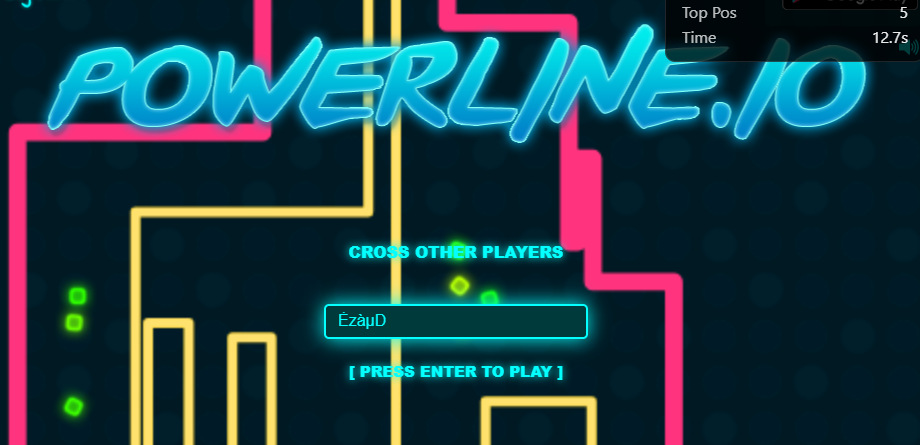
Powerline
Powerline is essentially Tron in a web-browser. It’s a multiplayer adversarial snake game where players compete to collect resources and control portions of the map. The gameplay is fast-paced and surprisingly complex. I’ve come to think of it as a kind of topological navigation of power structures. The most powerful users in the game have immensely long tails that define the playing field for all the others. When players die they leave massive caches of resources behind and a feeding frenzy ensues. It’s madness.
Even in my adult life I found myself playing this game for hours a day. Beyond the thrill of decapitating an arrogant king that uses his power to taunt and harass the poor players - it’s just fun to move around.
Movement
The connection between the mind and body can create a flow state. It has the same elements that other great games have - it’s fun to move, easy to play, but difficult to master. Entering this world gives me a break from the passive absorption of internet trash that makes my mind melt. Or perhaps it’s melting in another way.
I’ve been interested in movement mechanics since I was a kid playing Quake 3 after school. If movement is a major part of the draw for games, could I take that element and translate it elsewhere? Could navigating the web have a movement mechanic? I think yes.
I wanted to combine this with another subject I’ve been exploring for years: mapping. I’ll get to that a bit later. But for now: Immortal Dragon
Immortal Dragon
Immortal Dragon began as a single-player version of powerline focusing on smooth, satisfying movement. I broke the convention of 90 degree turns in favor of a kind of gliding mechanic where the user taps the spacebar to boost. This is something I call ‘waterbug’ navigation after an interesting description of an alien sighting I read in a book about ESP in Soviet Russia. The crafts were described as having ‘water bug’ movement - which for me partially solved the challenge of giving a user granular control over their speed without a pressure sensitive controller to act as the throttle.
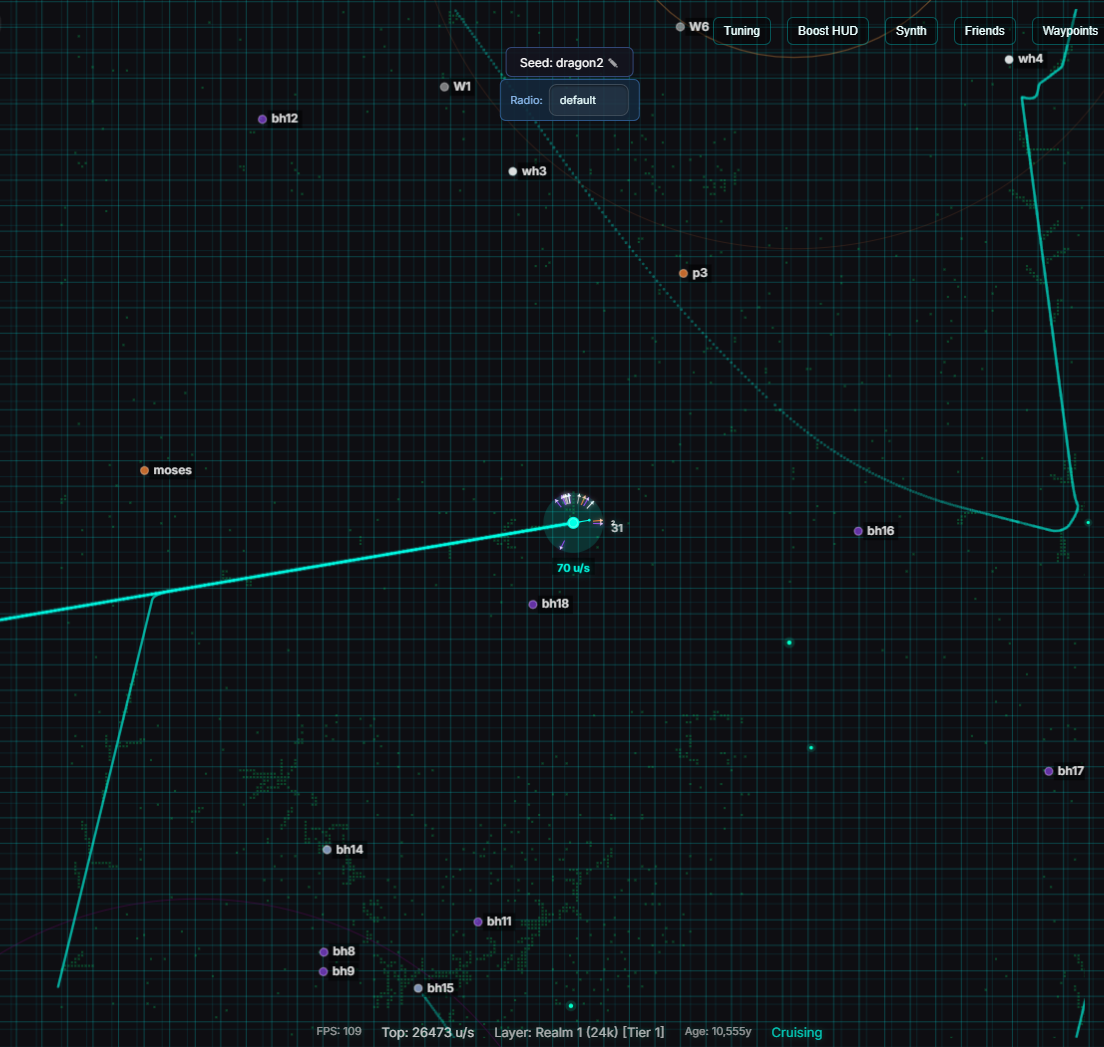 Immortal Dragon has slowly grown to be place for me to put all the weird features I’ve always wanted. With newer ai models - it’s fast.
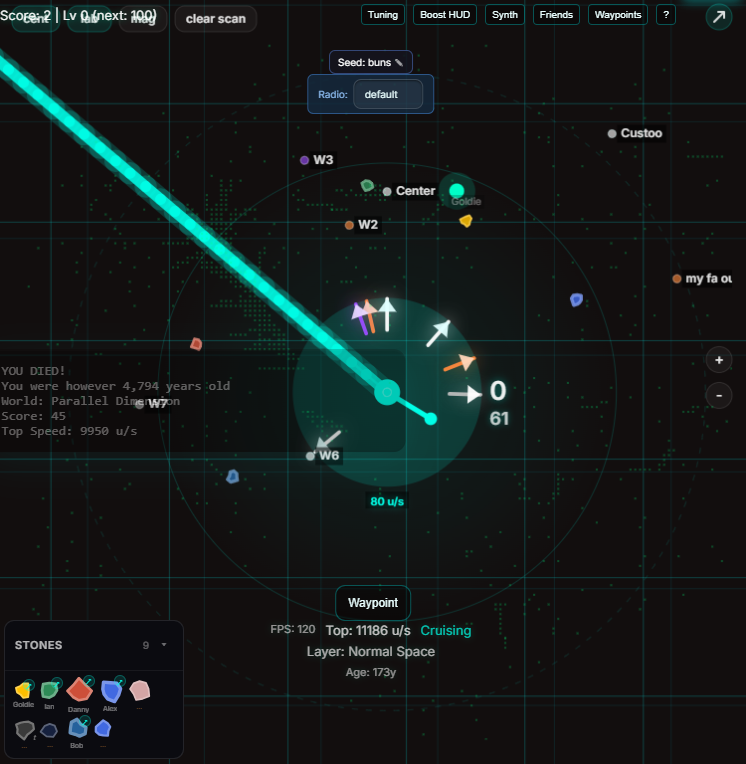
The above screenshot shows a bunch of features I love: Maps, inventory, waypoints, compass indicators and… rocks.
More about those features tomorrow.
- Jonny