Cloud
This page is to supplement my New Public application. Project is currently under development by Jonny Ostrem in Vancouver, BC - and seeking collaborators and support. To gain access or contribute to the conversation, please email my at jonnyostrem@gmail.com
Cloud is my dream of social media platform for artists and visual thinkers.
A cloud playfully refers to a several orders of organization at once. A cloud is a post, a canvas of images, text, links, sounds, and videos. A cloud also describes a cluster of clouds and so on. The language is meant to hint at the complexity of meaning, much of which is hidden from us by modern media systems.
Context
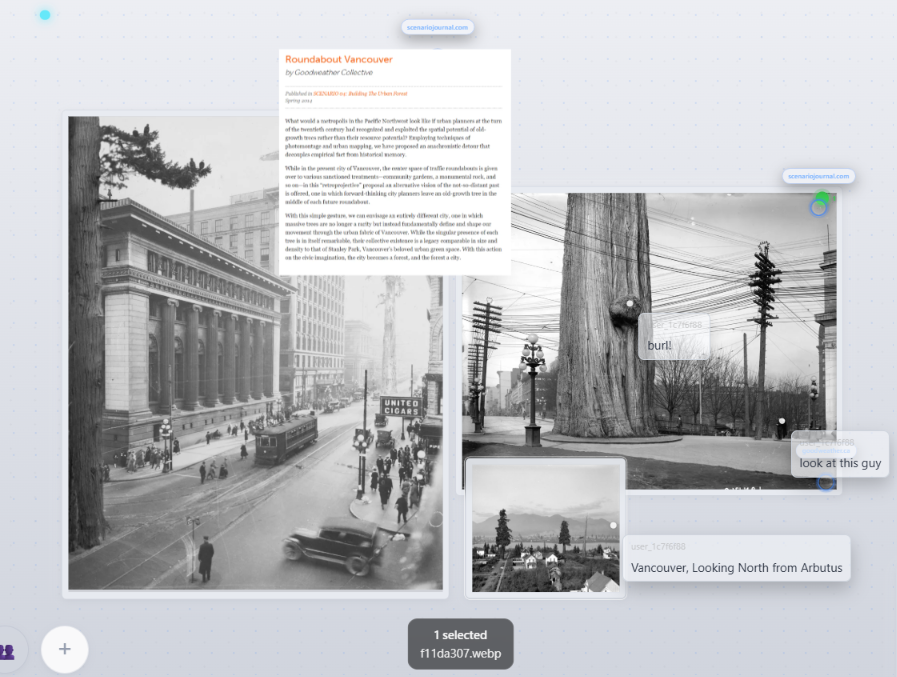
Conveying complexity of meaning requires context. Cloud gives users tools to create rich contextual representations of meaning. Adding related photos, writing, metadata, link and comments becomes an act of producing context.
Exploration
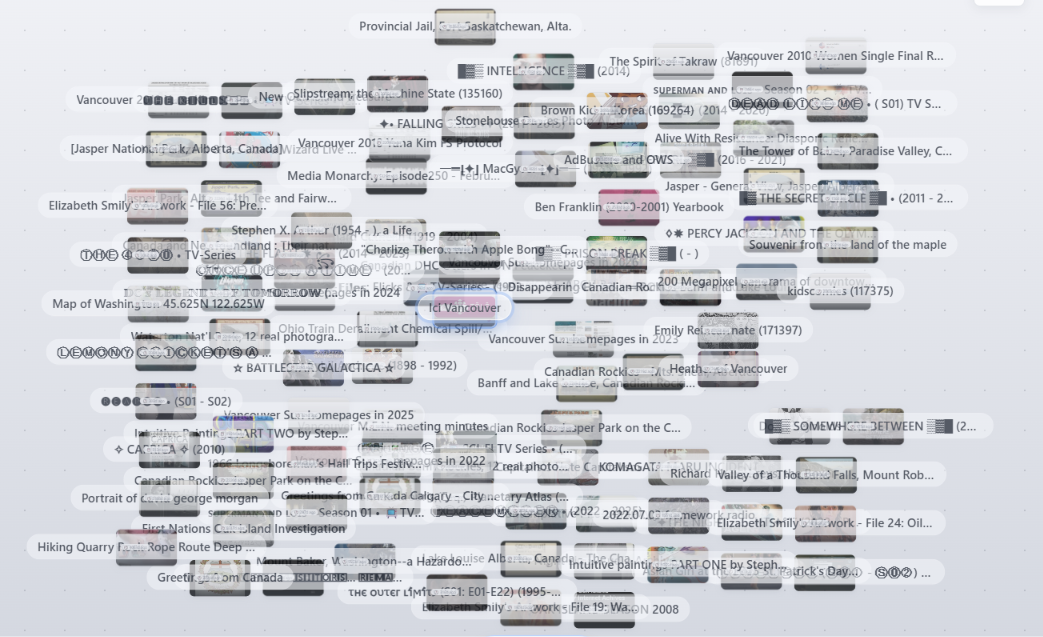
Here Internet Archive entries are rendered as a cloud of clouds. The user’s activity is to sort through media to find things that interest them. This is like scrolling, but with more degrees of freedom. Sorting and surfing become a few of the main activities.
The ‘Cloud Explorer’ replaces the timeline as a playground for finding new and related content.
Collecting
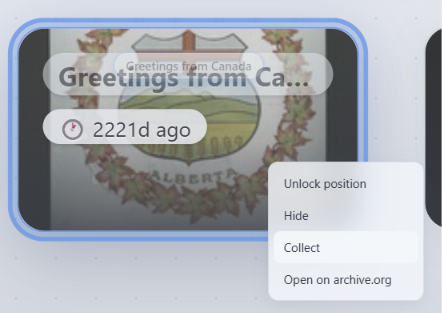
Items and clouds can be collected, their reference points saved for later to be added to a cloud later.
Navigation + Movement
In cloud, scrolling is replaced by cloud-surfing: the smooth navigation of clouds - clusters of information and images made by you and your connections. You can drag, organize and spatialize the places you’ve gone and others you plan to visit.
All movement are accessible through keyboard functions or through flick navigation. Movement around the canvas of a cloud uses something I call ‘focus navigation’ - clicking on a piece of media or text zooms your view to the object. Using mobile, you can use the joystick to flick in different directions, like scrolling in all directions.
Cloud Mapping
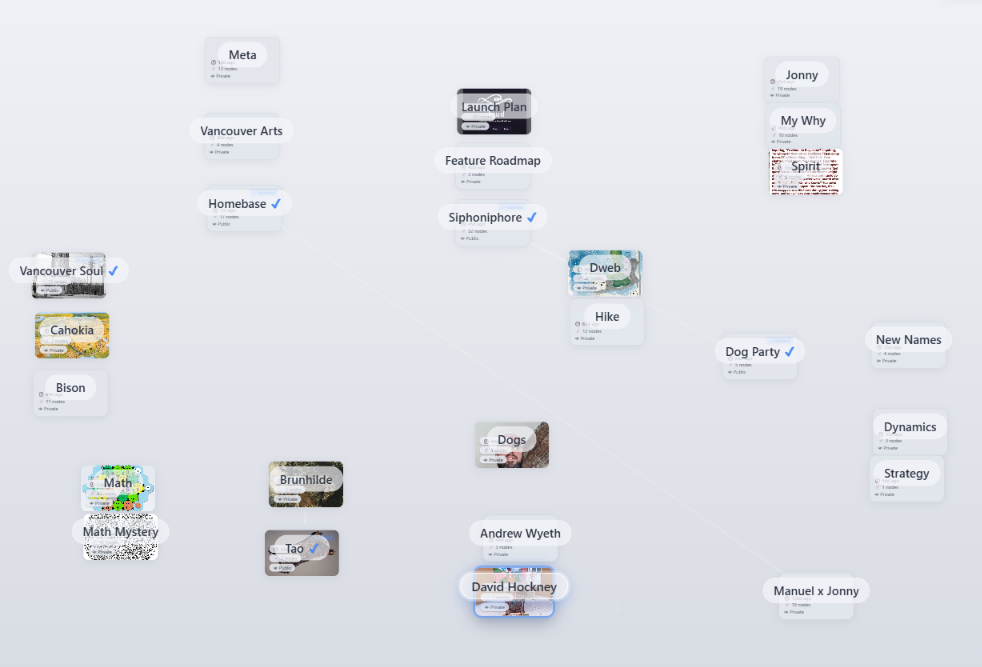
Each user has their own Cloud-Map - a place where their published and unpublished clouds are kept and organized. The draggable spatial arrangement of the clouds attempts to help the user form memory structures - returning to an unpublished post or thought in development might involve exploring a branch of their structure.
Friends and Connections
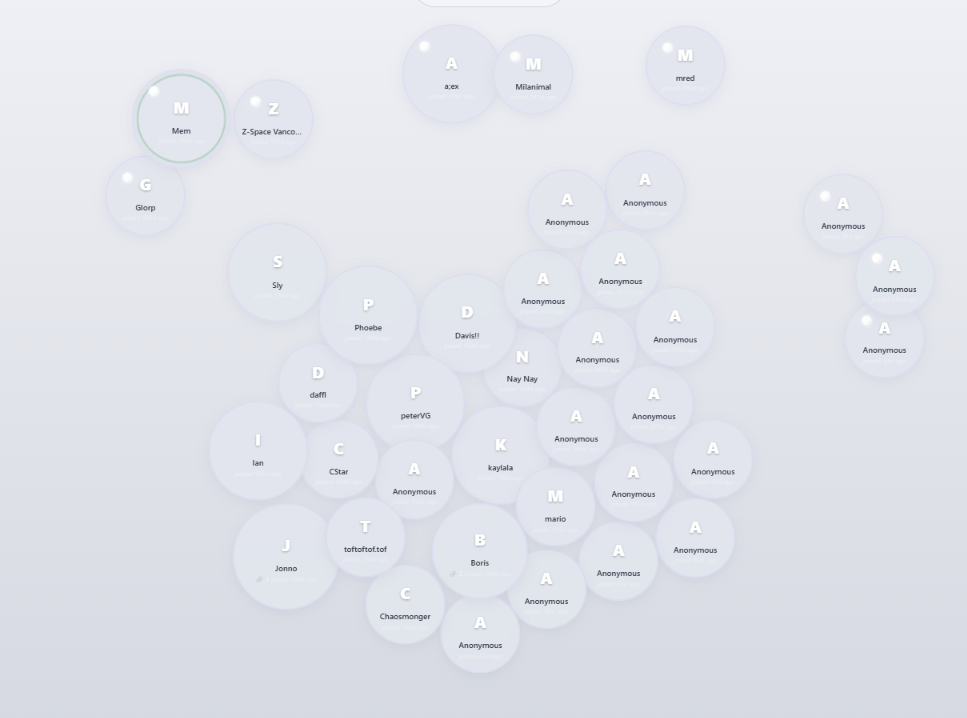
A spatial social list allows a user to organize others in groups and considered their intimacy gradients and permissions.
Users can manage their own social gradients and fine-tune permissions by proximity.
‘Semaphore Siphonophore’
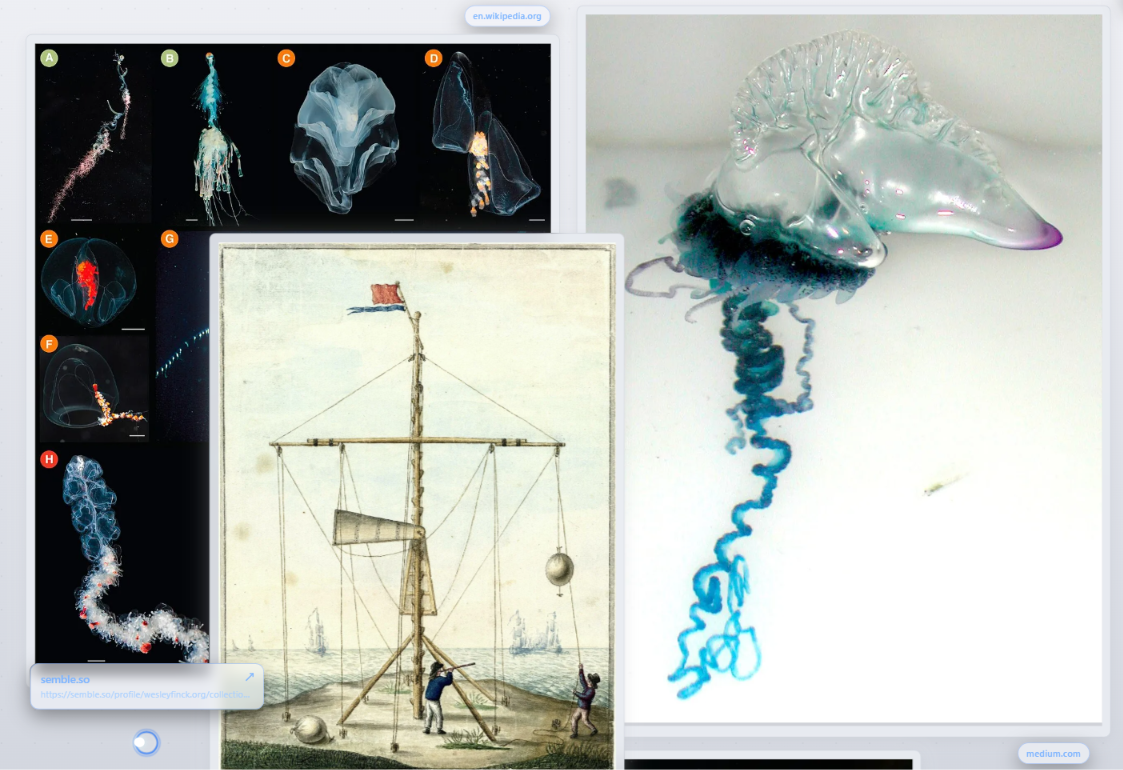 ‘Semaphore Siphonophore’ is the term I use to describe the design language and form of social relating and signaling in cloud. A siphonophore is a marine creature composed of a colony of zooids with specific functions that work together. A semaphore is a device used to communicate information visually over distances. Together this design language values visual emission of data and allows users to organize themselves into different special roles within a non-algorithmic content sorting structures - pulsing and emitting information about the state of the user network. One user might elect to consume unsorted material, others to sort certain categories or refine. Human groups become self-selected siphonophores feeding on human knowledge and emitting their state visually.
A Note:
The above is based on my own exploration and interest in interface. I’m interested in how this initial idea might be the seed for something larger. The claims made through my design choices are not intended as truth, but as conjecture to be tested.
- Jonny